BlogComparisons
Apollo vs Clearbit: Prospecting vs HubSpot Enrichment

By Rahul LakhaneyPublished on: May 20, 2026 · 10 min read · Last reviewed: May 2026
On this page
TL;DR
Apollo and Clearbit get compared constantly, but they solve different problems. Apollo is an all-in-one outbound prospecting and engagement platform. Clearbit, now folded into HubSpot as Breeze Intelligence, is an enrichment layer for the data you already have. Here is which fits your team — and where waterfall enrichment beats both.
Feature matrix across all tools reviewed
| Feature | Apollo | Clearbit | Enrich |
|---|---|---|---|
| Core purpose | Outbound prospecting + engagement | Enrichment for records & forms | Waterfall enrichment |
| Best for | SMB/mid-market outbound | HubSpot-native ops teams | Any team |
| Net-new prospecting | |||
| Engagement (email, dialer) | |||
| Standalone outside HubSpot | Limited | ||
| Free plan | 100 free credits | ||
| Pricing transparency | Public, self-serve | Bundled into HubSpot | Public, self-serve |
| Waterfall enrichment | |||
| MCP / AI agents |
Monthly cost by lookup volume
| Volume | Apollo (per seat) | Clearbit (Breeze) | Enrich |
|---|---|---|---|
| Free | $0, limited credits | Not offered standalone | 100 free credits |
| Entry | $49/user/mo | Bundled into HubSpot tiers | $49/mo (100K credits) |
| Mid-tier | $79/user/mo | Scales with HubSpot credits | $149/mo (500K credits) |
| Top tier | $119/user/mo | Tied to HubSpot contract | $499/mo (2.5M credits) |
Pick Apollo if you need to find and engage net-new prospects. Apollo's 275M+ contact and 73M+ company database, built-in sequences, and dialer let an SMB or mid-market team run a full outbound motion on one transparent per-seat bill, starting free.
Pick Clearbit if you live inside HubSpot and your main need is enriching inbound leads, form fills, and existing CRM records with firmographic data. As Breeze Intelligence, it installs natively and requires almost no setup if HubSpot is already your system of record.
Pick a waterfall enrichment layer like Enrich if your real problem is coverage and cost. Instead of relying on Apollo's single database or Clearbit's single enrichment source, waterfall enrichment queries several providers in sequence and keeps the first verified hit, which lifts match rates above any one tool while keeping you on transparent per-credit pricing.
Apollo is a sales engagement platform with a contact database attached. You search a B2B database of 275M+ contacts and 73M+ companies, push prospects into sequences, dial them with the built-in phone, and track deals, all without leaving the tool. For a team that wants to go from a blank list to first touch in one platform, that consolidation is the entire point.
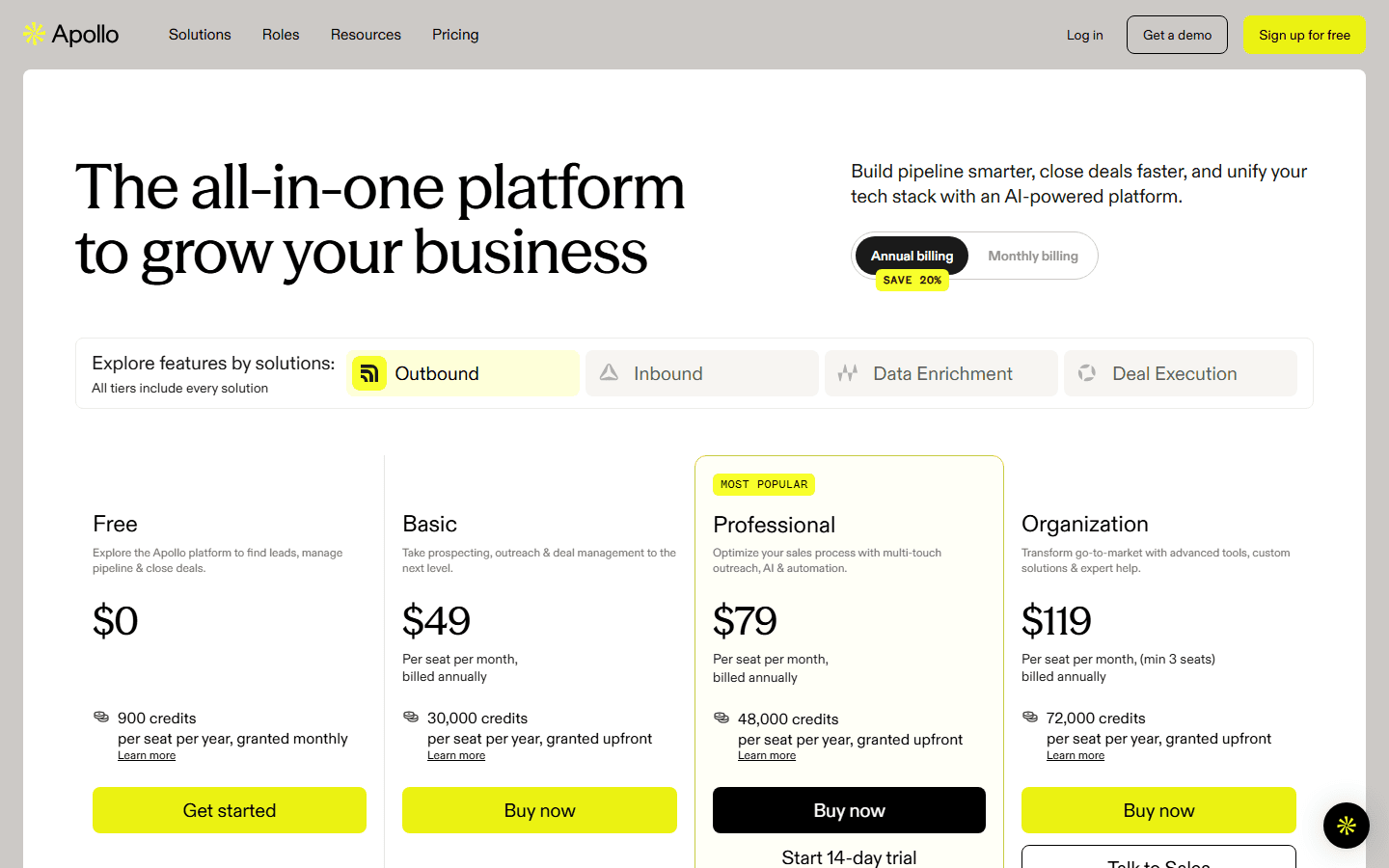
The pricing is the second reason smaller teams default to it. Apollo is public and self-serve: Free, Basic at $49 per user per month, Professional at $79, and Organization at $119 billed annually, so you can size a plan without a demo. The free plan is genuinely usable for testing, with a monthly credit allotment and access to sequences.
Where Apollo is weaker is enrichment hygiene on data you already own. It can enrich CRM records, but it is built around finding new contacts, not around keeping an existing HubSpot database clean on forms and workflows the way a native enrichment tool does.
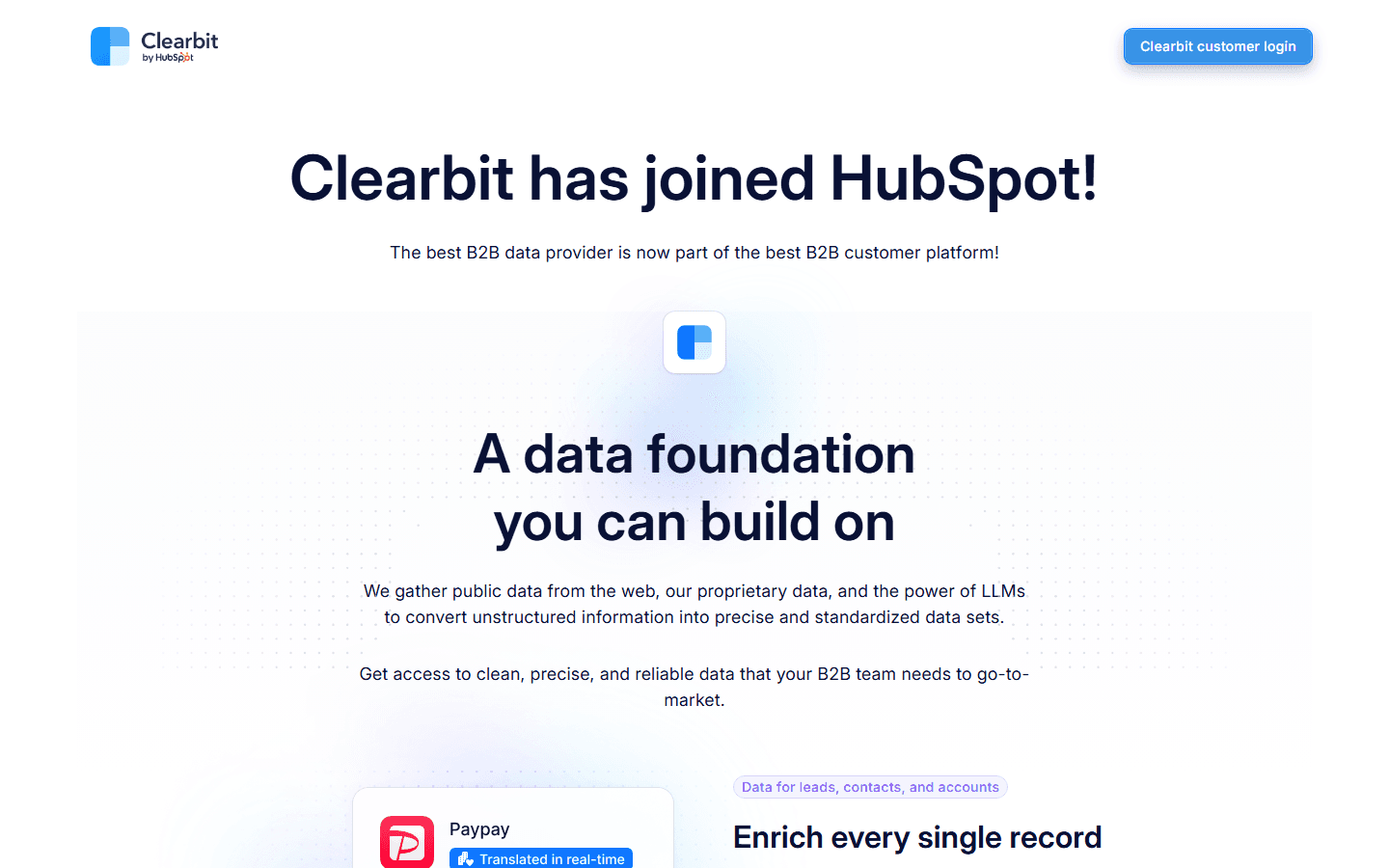
Clearbit's strength after the HubSpot acquisition is that it lives where your data already lives. As Breeze Intelligence, it enriches form submissions, contact and company records, and workflow steps natively inside HubSpot, so an inbound lead that arrives with just an email can be filled out with company size, industry, and role automatically. For HubSpot-first teams, the setup is close to zero.
That native fit drives the second benefit: it shortens forms and improves routing. Because enrichment happens at the point of capture, you can ask for fewer fields, score and route leads faster, and keep your CRM tidy without manual research.
The honest limitation is that Clearbit is primarily a single-source enrichment dataset and is far less useful outside HubSpot. Standalone access ended after the acquisition, free legacy tools were retired, and practitioners report that effective prices have risen and match rates have softened since the rebrand into Breeze packaging. It does not find net-new prospects or run any engagement.
Core purpose: Apollo is for finding and contacting people you do not know yet, building lists from a 275M+ contact database and pushing them into outreach. Clearbit is for enriching people who already entered your funnel. If you need new pipeline, Apollo is the tool; if you need cleaner existing data inside HubSpot, Clearbit is the tool.
Data model: Apollo gives you a searchable database you query with filters across titles, industries, and geographies. Clearbit gives you an enrichment layer that matches against a single source and writes attributes back into HubSpot records. Apollo's model is built for discovery; Clearbit's is built for completion.
HubSpot ecosystem fit: Clearbit wins decisively. As Breeze Intelligence it is native to HubSpot, enriching forms, records, and workflows with little configuration. Apollo integrates with HubSpot but is not built into it.
Pricing transparency: Apollo wins clearly. You can read every tier, start free, and upgrade self-serve. Clearbit's pricing is bundled into HubSpot and Breeze packaging and is not transparent on its own.
Engagement and outbound: Apollo bundles sequences, a dialer, and basic deal tracking into the base product. Clearbit has no engagement at all; it is purely an enrichment layer.
Apollo asks you to bet on one prospecting database, and Clearbit asks you to bet on one enrichment source inside HubSpot. The problem is the same in both cases: no single provider has the best coverage for every contact, in every region, at every seniority level. That is exactly what waterfall enrichment fixes.
Enrich queries multiple data sources in sequence for each contact and keeps the first verified result, so a record Apollo misses or Clearbit cannot complete might be filled by another provider in the chain. You get one CRM-ready record per prospect with both email and phone, higher overall match rates than any single tool, and transparent per-credit pricing instead of a bundled or annual deal. There is also an API and an MCP server for teams that want enrichment inside their own workflows and AI agents.
In practice, many teams keep Apollo for prospecting and sequencing, or keep HubSpot with Clearbit for inbound, and put Enrich underneath as the provider-agnostic data layer that lifts coverage on both.
Choose Apollo if you need to find and engage net-new prospects with transparent pricing and an all-in-one outbound workflow.
Choose Clearbit if you are HubSpot-first and your main job is enriching inbound leads, forms, and existing records with minimal setup.
Choose waterfall enrichment if your priority is the highest possible match rate and CRM-ready data without locking into one database or one enrichment source.
Not really. Apollo is an outbound prospecting and engagement platform that finds and contacts net-new leads, while Clearbit, now Breeze Intelligence, is a HubSpot-native enrichment layer for existing records and forms. They overlap on data but solve different jobs, and many teams use both.
Largely, yes. Since the HubSpot acquisition and the rebrand into Breeze Intelligence, Clearbit is designed to enrich forms, records, and workflows inside HubSpot, and standalone access has ended. Outside the HubSpot ecosystem, most of its advantage and ease of setup disappear.
Apollo. Its plans are public and self-serve, from a free tier up to Organization at $119 per user per month billed annually. Clearbit's cost is now bundled into HubSpot and Breeze packaging, which makes it harder to isolate.
Apollo can enrich records, but it is built around finding new contacts rather than continuously cleaning an existing HubSpot database the way a native enrichment tool does. For point-of-capture enrichment inside HubSpot, Clearbit fits better; for highest fill rates across providers, a waterfall layer fits best.
For teams that care most about coverage and cost, a waterfall enrichment platform is the strongest alternative because it is not tied to one database or one enrichment source. Enrich queries multiple providers in sequence and keeps the first verified hit, giving higher match rates than any single source at $49/mo for 100K credits.
100 free API credits. No credit card required. Start enriching data in minutes.