BlogComparisons
Apollo vs ZoomInfo: Which Wins in 2026?

By Rahul LakhaneyPublished on: May 20, 2026 · 11 min read · Last reviewed: May 2026
On this page
TL;DR
Apollo and ZoomInfo solve the same problem from opposite ends of the market. Apollo is self-serve with transparent pricing. ZoomInfo is enterprise with the deepest dataset and an annual contract to match. Here is which one fits your team — and where waterfall enrichment beats both.
Feature matrix across all tools reviewed
| Feature | Apollo | ZoomInfo | Enrich |
|---|---|---|---|
| Best for | Startups, SMBs | Mid-market, enterprise | Any team |
| Contract | Monthly or annual | Annual, sales-led | Monthly, self-serve |
| Free plan | 100 free credits | ||
| Per-seat pricing | |||
| Direct-dial phones | Credit-gated | Best in class (NA) | |
| Intent data | Higher tiers | Bombora add-on | |
| Built-in dialer | Engage add-on | ||
| Waterfall enrichment | |||
| MCP / AI agents |
Monthly cost by lookup volume
| Volume | Apollo (per seat) | ZoomInfo (annual) | Enrich |
|---|---|---|---|
| Entry | $49/user/mo | ~$15,000/yr | $49/mo (100K credits) |
| Mid-tier | $79/user/mo | $25,000+/yr | $149/mo (500K credits) |
| Top tier | $119/user/mo | $40,000+/yr | $499/mo (2.5M credits) |
| 5-person team (annual) | $4,740/yr | $15,000+/yr | $588/yr |
Pick Apollo if you are a startup or SMB sales team that wants prospecting, email sequencing, and dialing on one bill, with pricing you can see before a sales call. Apollo's 210M+ contact database is good enough for most outbound, and you can start free.
Pick ZoomInfo if you are mid-market or enterprise, you sell into North America, and direct-dial accuracy, intent data, and org charts justify a contract that usually starts around $15,000 per year.
Pick a waterfall enrichment layer like Enrich if your real problem is coverage and cost. Instead of betting on one provider's database, waterfall enrichment queries several sources in sequence and keeps the first verified hit, which lifts match rates above any single tool while keeping you on transparent per-credit pricing.
Apollo is a sales engagement platform with a contact database attached, not the other way around. You search a B2B database of 210M+ contacts, push prospects into sequences, dial them with the built-in phone, and track deals, all without leaving the tool. For a team that wants to go from list to first touch in one platform, that consolidation is the headline benefit.
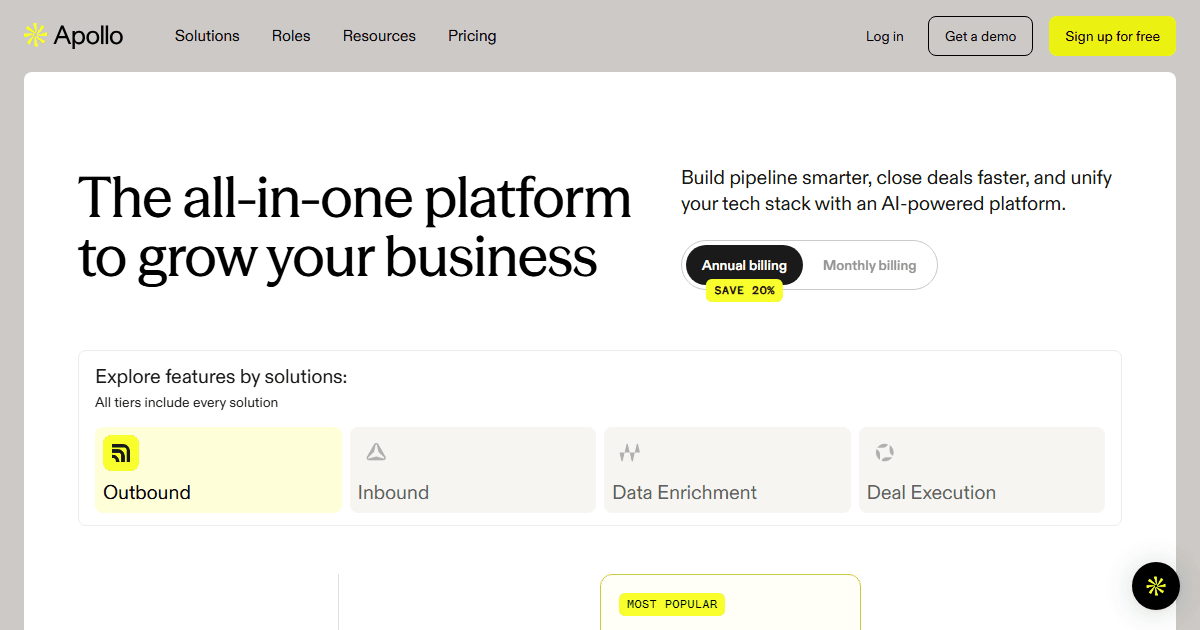
Three things make Apollo the default for smaller teams. First, pricing is public and self-serve: Free, Basic at $49 per user per month, Professional at $79, and Organization at $119 (billed annually), so you can size a plan without a demo. Second, the free plan is genuinely usable for testing, with a monthly credit allotment and access to sequences. Third, the data is broad enough that most SMB outbound motions never feel the ceiling.
Where Apollo gets thinner is direct-dial phone accuracy and intent depth. Mobile numbers are credit-gated and hit rates vary by region, and Apollo's intent signals are functional but not as rich as a dedicated intent provider.
ZoomInfo is the most complete B2B dataset in the category, and it shows up in the details. Direct-dial coverage in North America is the strongest in the market, org charts and reporting structures are mapped, technographics tell you what software a company runs, and Scoops surface buying signals like leadership changes and budget moves. Layer on Bombora-powered intent and WebSights visitor identification, and ZoomInfo becomes a full revenue-intelligence stack rather than a contact list.
That depth is the reason enterprise teams pay for it. When a single closed deal is worth five or six figures, paying for the most accurate direct dials and the earliest intent signal pays for itself quickly. ZoomInfo Copilot, the company's AI layer, adds account prioritization and recommended actions on top of that data.
The catch is everything around the data. Pricing is opaque and quoted per company, contracts are annual and sales-led, and the features that make ZoomInfo special, including intent, Copilot, and enrichment, are frequently priced as add-ons rather than included. Total cost for a real sales team usually lands well into five figures per year.
Data accuracy and coverage: ZoomInfo wins on raw accuracy, especially direct dials in North America and firmographic depth. Independent campaign tests routinely show lower bounce rates from ZoomInfo lists than from Apollo lists. Apollo wins on breadth and on email coverage for the price.
Phone and direct-dial data: This is ZoomInfo's clearest advantage. Its direct-dial database is deeper and more accurate in North America than Apollo's mobile coverage. If cold calling is your primary motion, ZoomInfo is the safer bet on phones alone.
Pricing and transparency: Apollo wins decisively. You can read every price, start free, and upgrade self-serve. ZoomInfo requires a sales conversation, bundles core value into add-ons, and locks you into an annual commitment. A three-rep startup can run Apollo for a few hundred dollars a month; the same team on ZoomInfo is usually looking at a five-figure annual contract.
Intent data and signals: ZoomInfo leads on signal richness with Bombora intent, Scoops, and WebSights. Apollo includes lighter intent on higher tiers, which covers basic prioritization but does not match a dedicated intent stack.
Compliance and global coverage: Both serve global data, but European coverage and GDPR posture are a known weak spot for US-first databases. Teams selling heavily into the EU often find that neither tool matches a Europe-focused provider like Cognism on phone-verified, compliant EU data.
Engagement and workflow: Apollo bundles sequences, a dialer, and basic deal tracking into the base product. ZoomInfo offers engagement through its Engage product, typically as a separate line item.
Both Apollo and ZoomInfo ask you to bet on a single database. The problem is that no single provider has the best coverage for every contact, in every region, at every seniority level. That is exactly what waterfall enrichment fixes.
Enrich queries multiple data sources in sequence for each contact and keeps the first verified result, so a record Apollo misses might be filled by another provider in the chain, and vice versa. You get one CRM-ready record per prospect with both email and phone, higher overall match rates than any single tool, and transparent per-credit pricing instead of an annual contract. There is also an API and an MCP server for teams that want enrichment inside their own workflows and AI agents.
In practice, many teams keep Apollo for sequencing and use Enrich as the data layer underneath it, or replace a ZoomInfo renewal with waterfall enrichment to cut cost without losing coverage.
Choose Apollo if you are a startup or SMB, you run email-led outbound, and you want transparent pricing and an all-in-one workflow.
Choose ZoomInfo if you are mid-market or enterprise, you sell by phone into North America, and direct-dial accuracy plus intent justify a five-figure contract.
Choose waterfall enrichment if your priority is the highest possible match rate and CRM-ready data without locking into one database or an annual deal.
ZoomInfo is generally more accurate on direct-dial phone numbers and firmographic depth, particularly in North America, where independent campaign tests show lower bounce and higher connect rates. Apollo is competitive on email coverage and breadth for a fraction of the price. For SMB email outbound, Apollo's accuracy is sufficient; for phone-led enterprise selling, ZoomInfo's edge is meaningful.
ZoomInfo prices for enterprise value: deeper data, intent signals, and account-level intelligence sold on annual contracts, often with intent and Copilot as add-ons. Apollo prices for self-serve adoption with public per-seat plans and a free tier. The gap reflects different buyers, not just different data.
Apollo offers a genuinely usable free plan with monthly credits and sequence access. ZoomInfo does not offer a free plan; you have to go through sales for a quote and a trial.
ZoomInfo, on phone data alone. Its direct-dial database is the most accurate in the category for North America. If cold calling is your primary channel, ZoomInfo's connect rates usually justify the cost.
For teams that care most about coverage and cost, a waterfall enrichment platform is the strongest alternative because it is not tied to one database. Enrich queries multiple data providers in sequence and keeps the first verified hit, giving you higher match rates than any single database at $49/mo for 100K credits.
100 free API credits. No credit card required. Start enriching data in minutes.