BlogComparisons
ZoomInfo vs RocketReach: Enterprise Depth or Affordable Lookup?

By Rahul LakhaneyPublished on: May 20, 2026 · 10 min read · Last reviewed: May 2026
On this page
TL;DR
ZoomInfo and RocketReach both give you B2B emails and phone numbers, but they serve different buyers. ZoomInfo is the enterprise standard with a five-figure annual contract. RocketReach is an affordable, self-serve lookup database you can buy in minutes. Here is which fits — and where waterfall enrichment beats both.
Feature matrix across all tools reviewed
| Feature | ZoomInfo | RocketReach | Enrich |
|---|---|---|---|
| Model | Enterprise database + intelligence | Affordable lookup database | Waterfall enrichment |
| Database | 321M+ contacts, 100M+ companies | Large lookup database, broad | Multi-source waterfall |
| Pricing | Custom, ~$15K+/yr | Public, credit-based, self-serve | Public, self-serve |
| Free plan | Limited free lookups | 100 free credits | |
| Direct dials | Best in class (NA) | Available, accuracy variable | |
| Intent data | Bombora, premium add-on | Minimal | |
| Self-serve signup | |||
| Best for | Mid-market & enterprise | SMB, recruiters, individuals | Any team |
| Waterfall enrichment |
Monthly cost by lookup volume
| Volume | ZoomInfo | RocketReach | Enrich |
|---|---|---|---|
| Free | Not offered | Limited free lookups | 100 free credits |
| Entry paid | ~$15,000/yr (custom) | Public, lookup/credit-based | $49/mo (100K credits) |
| Mid tier | Scales with seats & credits | Higher lookup volume | $149/mo (500K credits) |
| Top tier | Enterprise, custom | Team/scale credits | $499/mo (2.5M credits) |
Choose ZoomInfo if you are mid-market or enterprise, you sell into North America, and the deepest database, best direct dials, and intent signals justify a contract that usually starts around $15,000 per year.
Choose RocketReach if you are an SMB, a recruiter, or an individual who wants affordable, self-serve lookups, a browser extension, and broad coverage, and you can accept that accuracy is more variable than an enterprise database.
Choose a waterfall enrichment layer like Enrich if your real problem is coverage and cost. Instead of betting on one provider, waterfall enrichment queries several sources per contact and keeps the first verified hit, which lifts match rates above any single tool while keeping you on transparent per-credit pricing.
ZoomInfo is the most complete B2B dataset in the category, and it shows up in the details. Direct-dial coverage in North America is the strongest in the market, org charts and reporting structures are mapped, technographics reveal what software a company runs, and Scoops surface buying signals like leadership changes and budget moves. Add Bombora-powered intent and WebSights visitor identification, and ZoomInfo becomes a full revenue-intelligence stack, not just a contact list.
That depth is why enterprise teams pay for it. When a single closed deal is worth five or six figures, paying for the most accurate direct dials and the earliest intent signal pays for itself quickly. ZoomInfo Copilot, the company's AI layer, adds account prioritization and recommended actions on top of the data.
The catch is everything around the data. Pricing is opaque and quoted per company, contracts are annual and sales-led, and the features that make ZoomInfo special, including intent, Copilot, and enrichment, are frequently priced as add-ons. Total cost for a real sales team usually lands well into five figures per year, with no free plan and no self-serve path.
RocketReach is a large lookup database of emails and phone numbers wrapped in a fast, self-serve experience. You search a person or company, reveal contact details, and use the browser extension to pull data while you browse LinkedIn or a company site. Coverage is broad, the plans are credit or lookup-based, and you can sign up and start without talking to anyone. For SMBs, recruiters, and individuals, that accessibility is the headline.
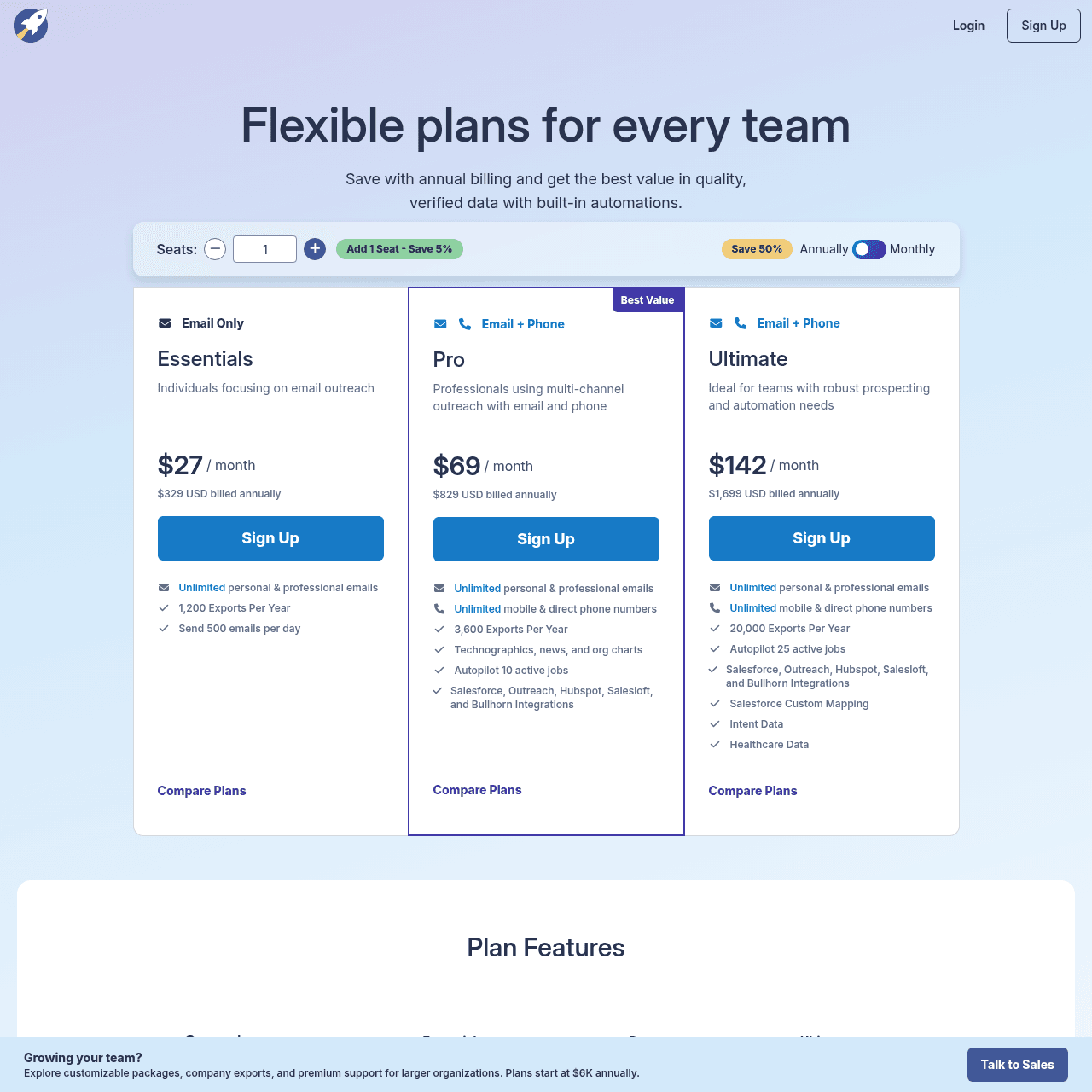
Pricing is public and self-serve, which is a sharp contrast to ZoomInfo. You can pick a plan, see exactly what each lookup costs, and scale up or down without a contract or a procurement cycle. For teams that just need contacts on demand at a predictable, modest cost, RocketReach is an easy on-ramp.
The honest limitation is accuracy and depth. RocketReach's data quality is reported as more variable than an enterprise database, so bounce and connect rates can be inconsistent, and it is light on intent, intelligence, and engagement. The right move is to validate data against your real target accounts and treat RocketReach as a coverage source rather than a single source of truth. For the cost detail, see our RocketReach pricing breakdown.
Data accuracy and depth: ZoomInfo wins clearly on raw accuracy and firmographic depth, especially in North America. Independent campaign tests routinely show low bounce rates from ZoomInfo lists, while RocketReach's accuracy is reported as more variable. RocketReach's strength is broad coverage at a low price, which is enough for many SMB and recruiting workflows.
Phone and direct-dial data: This is one of ZoomInfo's clearest advantages. Its direct-dial database is the deepest and most accurate in North America, which matters enormously for cold-calling teams. RocketReach provides phone numbers too, but accuracy is more variable.
Pricing and contract: This is the largest gap between the two. ZoomInfo requires a sales conversation and an annual contract that typically starts around $15,000 per year, with core value sold as add-ons. RocketReach is public, self-serve, and credit-based, so a small team or individual can run it for a tiny fraction of a ZoomInfo deal.
Intent and intelligence: ZoomInfo leads decisively with Bombora intent, Scoops, WebSights, technographics, org charts, and Copilot. RocketReach is minimal here; it is built around lookups, not a full intelligence layer.
Self-serve vs sales-led: RocketReach wins on accessibility. You sign up, buy credits, and start, with the browser extension making lookups frictionless. ZoomInfo requires a demo, a quote, and an annual commitment.
Both ZoomInfo and RocketReach ask you to bet on a single database, one deep and expensive, the other broad and affordable. The problem is that no single provider has the best coverage for every contact, in every region, at every seniority level. That is exactly what waterfall enrichment fixes.
Enrich queries multiple data sources in sequence for each contact and keeps the first verified result, so a record one source misses might be filled by another in the chain. You get one CRM-ready record per prospect with both email and phone, higher overall match rates than any single tool, and transparent per-credit pricing instead of an annual contract, plus an API and MCP server for teams that want enrichment inside their own workflows and AI agents. Many teams replace a ZoomInfo renewal with waterfall enrichment to cut cost without losing coverage, or layer it over RocketReach to lift match rates and consistency.
Choose ZoomInfo if you are mid-market or enterprise, sell into North America, and the deepest data plus intent justify a five-figure contract.
Choose RocketReach if you are an SMB, recruiter, or individual who wants affordable, self-serve lookups and broad coverage.
Choose waterfall enrichment if your priority is the highest possible match rate and clean CRM data without locking into one database or an annual deal.
ZoomInfo is generally more accurate, especially on direct-dial phones and firmographic depth in North America, where independent campaign tests show low bounce rates. RocketReach offers broad coverage at a low price but with more variable accuracy. For enterprise-grade quality, ZoomInfo is the safer choice; with RocketReach, validate data on your accounts.
Yes, dramatically. RocketReach is public, self-serve, and credit-based, while ZoomInfo requires an annual contract that typically starts around $15,000 per year with add-ons. A solo user on RocketReach can spend a tiny fraction of a ZoomInfo deal.
RocketReach offers limited free lookups so you can test the database before buying credits. ZoomInfo does not offer a free plan; you have to go through sales for a quote and a trial.
ZoomInfo, on phone data alone. Its direct-dial database is the most accurate in the category for North America. RocketReach provides phone numbers too, but accuracy is more variable, so connect rates can be inconsistent.
For teams that care most about coverage and cost, a waterfall enrichment platform like Enrich is the strongest alternative because it is not tied to one database. See our best ZoomInfo alternatives and best RocketReach alternatives roundups for the full field.
100 free API credits. No credit card required. Start enriching data in minutes.