BlogComparisons
Cognism vs ZoomInfo: Enterprise Data Providers Compared

By Rahul LakhaneyPublished on: Mar 30, 2026 · 10 min read · Last reviewed: Mar 2026
On this page
TL;DR
Cognism and ZoomInfo both cost $15K+ per year with annual contracts. I compared their databases, phone verification, EMEA coverage, and intent data, then found a third option at $49/mo.
Feature matrix across all tools reviewed
| Feature | Feature | Cognism | ZoomInfo | Enrich |
|---|---|---|---|---|
| Database size | 100M+ | 100M+ | 300M+ | |
| Phone-verified numbers | Diamond Data | |||
| Intent data | Bombora | Bidstream | ||
| Email Finder | ||||
| Email Validation | ||||
| Reverse Email Lookup | ||||
| Waterfall Enrichment | ||||
| Lead Finder (300M+) | ||||
| EMEA coverage | Strong | Moderate | Global | |
| MCP / AI Agents | ||||
| Credit-based pricing | ||||
| No annual contract |
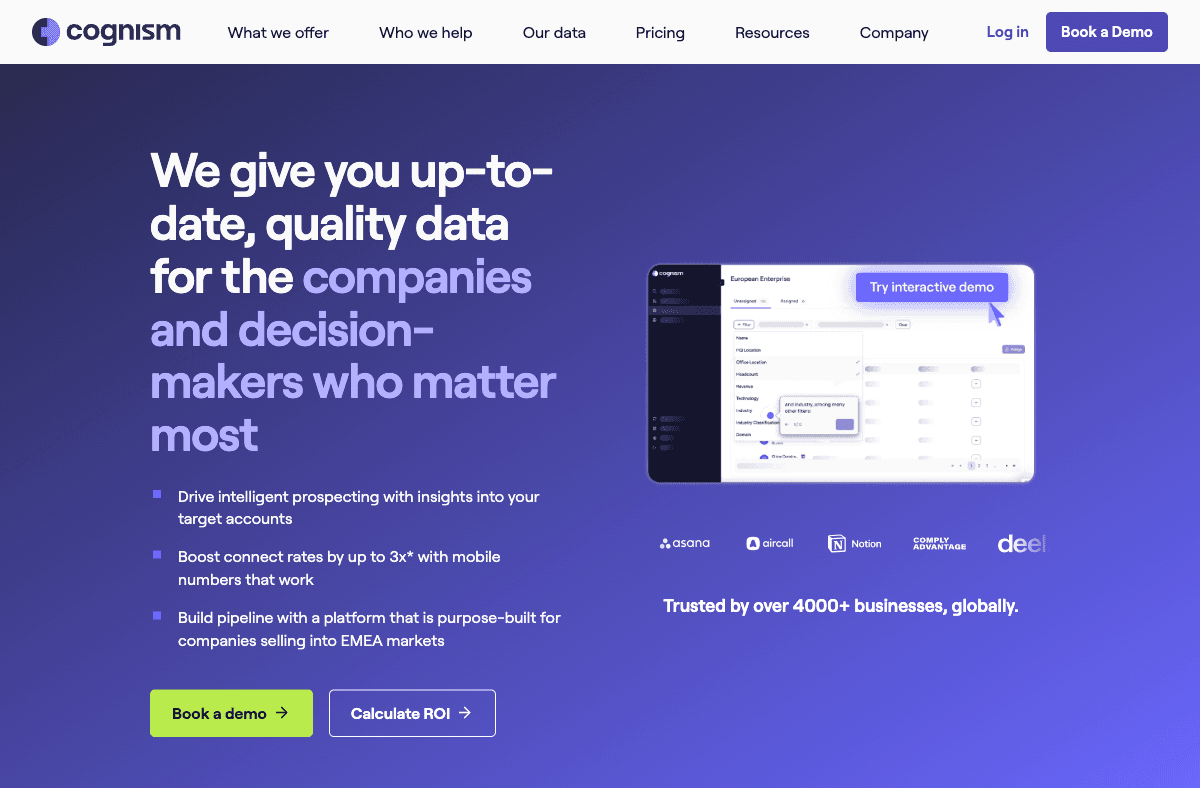
Cognism differentiates itself with Diamond Data: phone numbers that are manually verified by their research team. In my testing, these verified numbers delivered noticeably higher connect rates on cold calls compared to standard phone data from other providers. If your sales team relies heavily on cold calling, Diamond Data is a genuine competitive advantage.
Cognism's strongest coverage is in Europe, the Middle East, and Africa (EMEA). For teams selling into European markets, Cognism consistently surfaces contacts that US-centric providers miss. The platform also integrates Bombora intent data, letting you see which accounts are actively researching topics related to your product.
The platform includes a Chrome extension for LinkedIn, CRM integrations with Salesforce and HubSpot, and compliance features designed for GDPR. Cognism takes data privacy seriously, which matters for EU-based teams.
The downside is enterprise pricing. Cognism typically costs $15,000 to $25,000 per year with mandatory annual contracts. There is no self-serve option, no free tier, and no way to test the platform without going through a sales process. Per-seat pricing means adding team members increases your bill. Coverage outside of EMEA and North America (particularly APAC) is weaker than competitors.
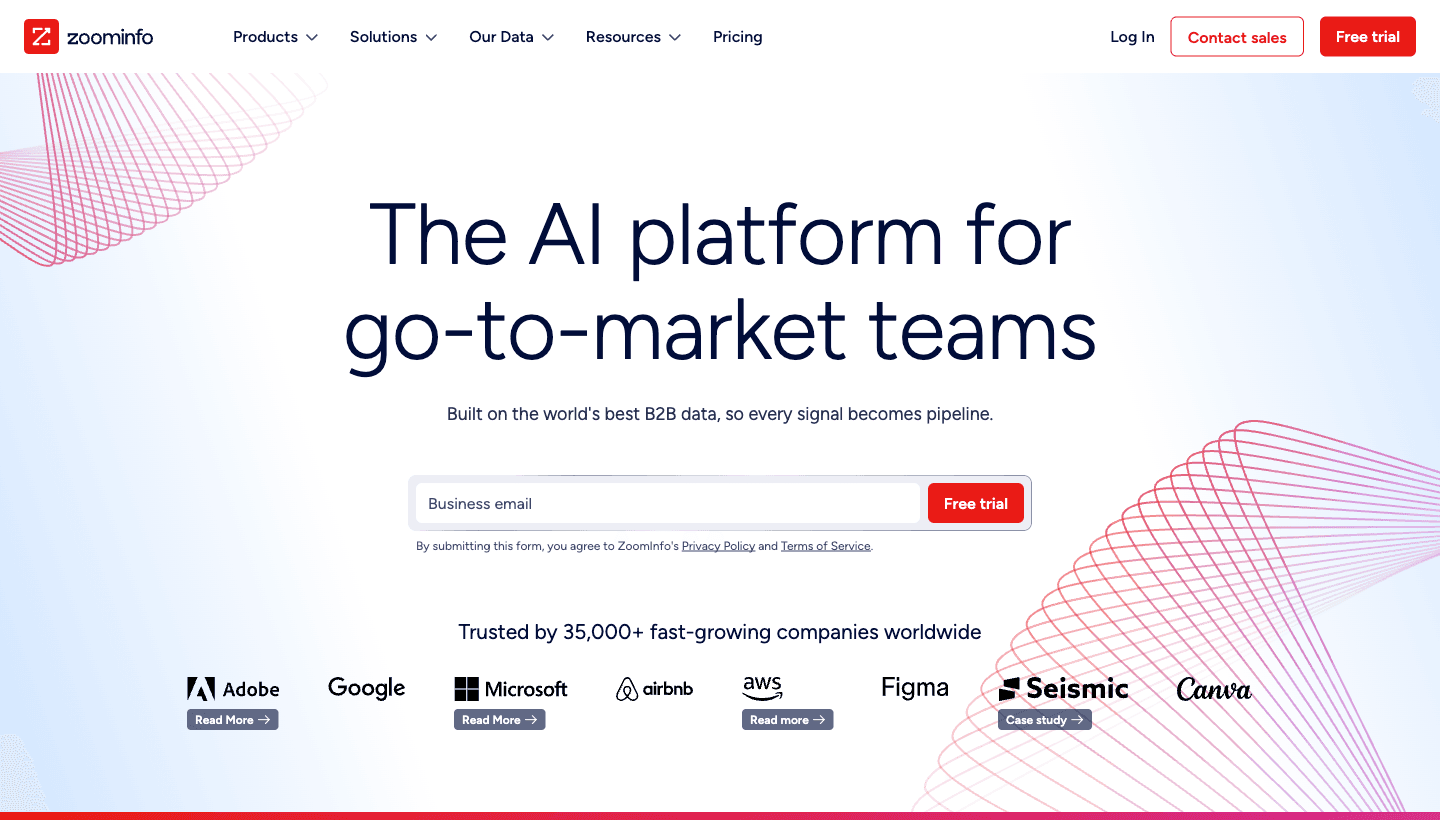
ZoomInfo has the broadest and deepest B2B data platform in the market. With 100M+ contacts, Bidstream intent data, technographic profiles, org chart visualization, and advanced account-based filtering, ZoomInfo is the tool that enterprise sales teams benchmark everything else against.
In my experience, ZoomInfo's US database is unmatched. Contact coverage for mid-market and enterprise US companies is excellent, and the intent data (tracking which accounts are researching relevant topics) is genuinely actionable when you have the processes to act on it. Org charts let you map buying committees visually, which is powerful for complex enterprise sales cycles.
ZoomInfo also has the deepest integration ecosystem: Salesforce, HubSpot, Marketo, Outreach, SalesLoft, and dozens of other tools. If you are running a mature sales tech stack, ZoomInfo plugs in cleanly.
The pricing barrier is identical to Cognism. ZoomInfo starts at $15,000+ per year with mandatory annual contracts. Most teams I have spoken with pay $25,000 to $40,000 per year once you factor in seats, data tiers, and add-ons like intent data and technographic profiles. Implementation takes weeks, and the platform has a steep learning curve with dozens of modules.
ZoomInfo's EMEA coverage is improving but still trails Cognism's European strength. The opaque credit system makes it hard to predict costs, and overage charges can surprise teams mid-contract.
Cognism and ZoomInfo are the two biggest enterprise data providers, and choosing between them usually comes down to geography, phone data priority, and intent data source.
Database and geography: ZoomInfo has the larger US database and broader global coverage overall. Cognism has significantly stronger EMEA coverage. If you primarily sell into European markets, Cognism wins. If you sell into the US or globally, ZoomInfo has an edge.
Phone data quality: Cognism's Diamond Data is the gold standard for verified phone numbers. ZoomInfo has phone data but does not offer the same manual verification process. For cold-calling-heavy teams, Diamond Data is worth the Cognism premium.
Intent data: ZoomInfo uses Bidstream intent data (tracking web browsing signals at scale). Cognism integrates Bombora intent data. Both are useful for identifying accounts in active buying cycles. ZoomInfo's intent coverage is broader; Bombora's data is considered more privacy-compliant in European markets.
Pricing: Both cost $15,000+ per year with annual contracts. In practice, teams often pay $20K to $40K per year depending on seats and features. Neither offers monthly billing, self-serve signup, or a free tier.
Feature gaps in both: Neither Cognism nor ZoomInfo offers waterfall enrichment (multi-source cascading lookups), credit-based pricing (pay for usage, not seats), or MCP server support (AI agent integration). Both lack reverse email lookup as a standalone endpoint. These are not enterprise features they chose to skip; they are fundamental capabilities that modern enrichment workflows need.
The real question is whether you need everything these enterprise platforms provide, or whether you are paying $15K+/year primarily for the enrichment data layer.
Enrich is not trying to be an enterprise sales intelligence platform. It does not have Cognism's Diamond Data phone verification team or ZoomInfo's Bidstream intent data. What it does have is the enrichment layer that both platforms charge $15K+/year for, available from $49/mo.
Here is what Enrich delivers:
Larger contact database: Enrich's Lead Finder indexes 300M+ contacts, compared to 100M+ for both Cognism and ZoomInfo. Search with 100+ filters including job title, seniority, industry, company size, technographics, funding data, hiring signals, and traffic data. Free count queries let you size your audience before spending credits.
Full-stack enrichment API: Email Finder (10 credits), Email Validation (1 credit), Reverse Email Lookup (10 credits), Phone Finder (500 credits), People Search (1 credit/person), and Waterfall Enrichment with ICP scoring (1 credit/record). All accessible through REST API, TypeScript SDK, Go SDK, or MCP server.
Credit-based pricing with no seat limits: Growth Pack $49/mo (100K credits), Scale Pack $149/mo (500K credits), Pro Pack $499/mo (2.5M credits). Your entire team shares one credit pool. No annual contracts, cancel anytime.
AI agent integration: The MCP server connects to Claude, ChatGPT, Cursor, and VS Code. Teams can enrich data through natural language without writing API calls.
The trade-off is clear. If you need intent data to prioritize accounts showing buying signals, or if you need Cognism's manually verified phone numbers for high-volume cold calling, those are capabilities that justify the enterprise price tag. But if your primary need is accurate contact and company enrichment via API, Enrich delivers comparable data quality at 1/30th the price.
For many teams, the practical approach is to use Enrich for day-to-day enrichment ($49/mo) and layer in intent data from a dedicated provider only if and when you need it.
Cognism is the right choice for teams that do heavy cold calling into EMEA markets and need Diamond Data phone-verified numbers. ZoomInfo is the right choice for enterprise teams that need the deepest possible US database with intent data, org charts, and a mature integration ecosystem.
But both cost $15,000+ per year, require annual contracts, and charge per seat. For teams that primarily need the enrichment data layer, the API, and the contact database, Enrich delivers 94%+ enrichment accuracy, 300M+ contacts, and full-stack enrichment from $49/mo.
Test it yourself with 100 free credits at dash.enrich.so. No credit card, no sales process, no annual commitment.
Yes. Cognism has significantly stronger EMEA coverage and Diamond Data (manually phone-verified numbers) that deliver higher connect rates in European markets. ZoomInfo has the larger US database. For teams selling primarily into Europe, Cognism is the better choice between the two. Enrich offers global coverage from $49/mo.
Both platforms bundle intent data, advanced analytics, org charts, and large sales teams into their pricing. You are paying for the full enterprise platform, not just the data. If you only need the enrichment layer (email, phone, company data), Enrich provides comparable data quality from $49/mo without the enterprise overhead.
No. Enrich focuses on contact and company enrichment: email finding, phone finding, reverse lookup, waterfall enrichment, and lead finding. It does not include intent data (which accounts are actively researching topics). If you need intent signals, consider pairing Enrich with a dedicated intent provider like Bombora or G2.
Rarely. Both require $15,000+ per year with annual contracts, which exceeds most startups' entire software budget. Enrich offers the same enrichment capabilities from $49/mo ($588/year) with no annual commitment, making it the practical choice for startups and SMBs.
100 free API credits. No credit card required. Start enriching data in minutes.