CompareClay.com
EnrichvsClay.com

Enrich vs Clay

Last reviewed: March 2026

Flat-rate enrichment API vs per-credit waterfall platform

Clay is a waterfall data enrichment platform that connects 75+ data providers to maximize coverage. Enrich is an API-first enrichment platform with its own 300M+ contact database, Lead Finder, Waterfall ICP Search, and People Search. Clay's strength is aggregating multiple vendors. Enrich's strength is providing comprehensive enrichment from a single API at a fraction of the cost.

What is Clay.com?

Clay is a data enrichment and outreach platform that pioneered the waterfall enrichment model. Clay holds a 4.6/5 rating on G2 based on 200+ reviews, with users praising its flexibility and integrations. Instead of relying on a single data source, Clay queries multiple data providers (75+) in sequence until it finds the data you need. This approach maximizes coverage by combining data from providers like Apollo, Clearbit, Hunter, ZoomInfo, and others. See Clay reviews on G2.

Clay's spreadsheet-like interface lets users build enrichment workflows visually. Each column can trigger a different enrichment, and AI features (Claygent) can research companies and write personalized outreach. Clay integrates with outreach tools like Instantly, Smartlead, and HubSpot.

However, Clay's credit system can be expensive. Each enrichment action consumes credits, and waterfall enrichments that query multiple providers use more credits per lookup. The platform also adds complexity: you are managing multiple data provider connections, each with different quality characteristics.

Clay.com platform showing waterfall enrichment with multiple data providers
Clay's waterfall enrichment queries multiple data providers sequentially. Pricing is based on enrichment credits that vary by provider and data type.
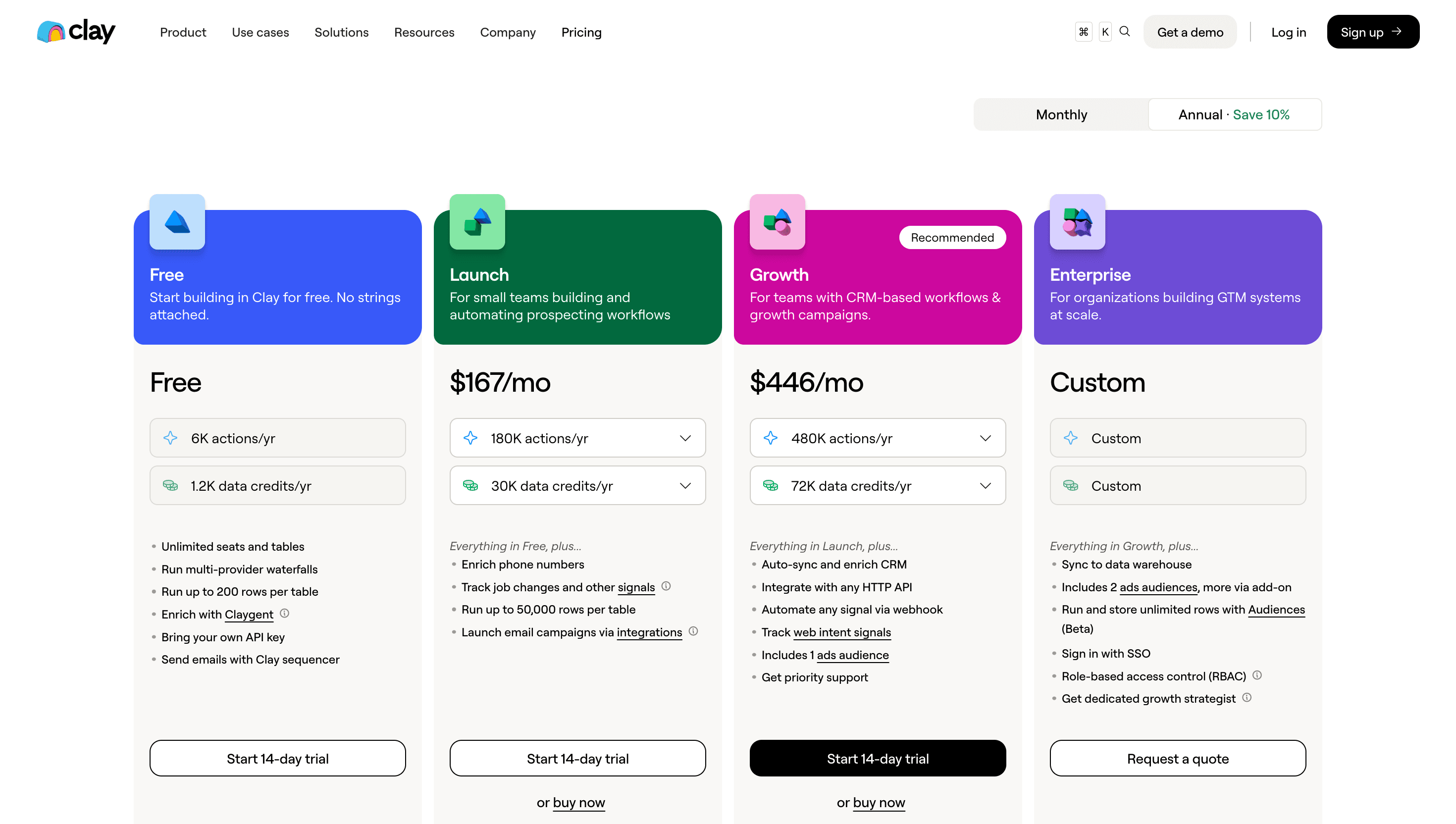
Clay pricing page showing plans and costs
Clay pricing: Free (100 credits/mo), Starter ($149/mo, 2,000 credits), Explorer ($349/mo, 10,000 credits), Pro ($800/mo, 50,000 credits), and Enterprise (custom). Annual billing on paid plans.

Pricing: Enrich vs Clay.com

Clay.com pricing

Free$0

100 credits/mo. Limited features.

Starter$149/mo

2,000 credits/mo. Basic enrichments. Annual billing.

Explorer$349/mo

10,000 credits/mo. Waterfall enrichment. AI features.

Pro$800/mo

50,000 credits/mo. Advanced waterfall. Priority support.

EnterpriseCustom

Unlimited tables. Custom integrations. Dedicated support.

Enrich pricing

Free$0

100 credits. No credit card required.

Growth Pack$49/mo

100,000 credits ($0.0005/credit). No per-seat fee.

Scale Pack$149/mo

500,000 credits ($0.0003/credit). No contracts.

Pro Pack$499/mo

2,500,000 credits ($0.0002/credit). Best value at scale.

EnterpriseCustom

Talk to sales for custom volume.

Pricing verdict
Clay's Starter plan provides 2,000 credits for $149/mo. Enrich's Growth Pack provides 100,000 credits for $49/mo. That is 50x more credits for 67% less cost. At Clay's Pro level ($800/mo for 50,000 credits), Enrich's Scale Pack offers 500,000 credits for $149/mo, which is 10x more credits at 81% less cost. Clay's waterfall approach also means a single lookup can consume multiple credits as it queries multiple providers, further widening the cost gap.

See full Enrich pricing with all plan details.

Feature comparison

Feature
Enrich
Clay.com
Pricing (similar volume)
$49/mo for 100,000 credits
$149/mo for 2,000 credits (Starter)
Enrichment approach
Single API with built-in data, Waterfall ICP Search
Waterfall across 75+ third-party providers
Email Finder
email accuracy above 94% in independent testing, response times under 200ms
Via waterfall across multiple providers
Email Validation
SMTP verification, catch-all & disposable detection
Via third-party providers in waterfall
Phone Finder
Direct phone numbers via API
Via waterfall providers
Lead Finder
a 300M+ contact database, 100+ filters, 1 credit/person
No proprietary database (relies on connected providers)
People Search / Employee Finder
Find employees by company, title, seniority (1 credit)
Via connected provider APIs
Waterfall ICP Search
Cascading multi-source ICP matching, 0-100 scoring, 1 credit/record
Waterfall enrichment across providers (multi-credit per lookup)
Company Follower Analysis
Analyze company followers for lookalike targeting (25 credits/follower, free count)
Not available natively
Technographic Filters
Filter by CRM, marketing automation, cloud provider
Technology data via providers (additional credits)
Funding & Hiring Signals
Funding rounds and hiring trends in Lead Finder
Available via connected providers
AI features
Native MCP server for Claude, OpenAI, Gemini
Claygent AI research and personalization
Bulk processing
Up to 500K records per batch with webhooks
Table-based processing with row limits
API design
REST API, Node.js and Go SDKs, MCP server
Platform-first, API secondary
CRM Integration
Salesforce, HubSpot native integrations
HubSpot, Salesforce, and 100+ integrations

Clay's waterfall model vs Enrich's integrated approach

Clay pioneered waterfall enrichment: querying Provider A, then Provider B, then Provider C until data is found. This maximizes coverage but has downsides. Each provider in the waterfall consumes credits. A single enrichment can cost 3-10+ credits depending on how many providers are queried. Data quality varies across providers, and Clay cannot control it.

Enrich takes a different approach. Instead of aggregating third-party providers, Enrich maintains its own 300M+ contact database with built-in Waterfall ICP Search that scores leads 0-100 for just 1 credit per record. You get the benefits of multi-source matching without the per-provider credit burn. As one G2 reviewer noted: 'Powerful workflows, but between Clay credits and provider API costs, each enriched record ended up costing us $0.30 or more.'

When Clay makes sense

Clay excels for teams that need a visual workflow builder for complex enrichment sequences. The spreadsheet interface lets non-technical users chain multiple enrichment steps without writing code. Claygent's AI can research companies, find specific information from websites, and write personalized email copy.

However, if your primary need is programmatic data enrichment at scale, Clay's UI-first approach adds complexity and cost. Enrich's REST API, typed SDKs, and webhook-based bulk processing are purpose-built for developers integrating enrichment into automated workflows.

Cost comparison at scale

A team enriching 10,000 contacts per month on Clay's Explorer plan ($349/mo, 10,000 credits) would consume their entire monthly credit allotment in a single batch, and that assumes 1 credit per enrichment, which is optimistic for waterfall lookups. Enrich's Growth Pack ($49/mo, 100,000 credits) handles the same volume 10x over.

At 50,000 contacts per month, Clay requires the Pro plan at $800/mo. Enrich's Scale Pack provides 500,000 credits for $149/mo. The cost gap at scale is enormous: $800/mo vs $149/mo for 10x more capacity.

Data ownership and control

Clay aggregates data from 75+ providers, each with their own terms of service, data freshness, and accuracy. If a provider changes their API or pricing, it affects your Clay workflow. Enrich owns and maintains its data pipeline, giving you consistent data quality, predictable pricing, and no dependency on third-party provider availability.

Enrich's data includes verified emails, phone numbers, company firmographics, social profiles, technographic data, funding information, and hiring signals, all accessible through a single API endpoint.

Why teams choose Enrich over Clay.com

Pros
  • 50x more credits per dollar: Enrich provides 100,000 credits for $49/mo. Clay provides 2,000 credits for $149/mo. Even accounting for different credit values, Enrich delivers dramatically more enrichments per dollar spent. Enrich holds a 4.7/5 rating on Capterra based on 53 verified reviews.
  • Proprietary 300M+ contact database: Enrich has its own data. Clay aggregates data from 75+ third-party providers, which means Clay's data quality depends on those providers. Enrich controls its data pipeline end to end.
  • Simpler, predictable pricing: Enrich credits have fixed costs. Clay credits vary by provider and data type, making it hard to predict monthly spend. A single waterfall enrichment on Clay can consume 3-10+ credits.
  • API-first architecture: Enrich is built as an API with typed SDKs, webhooks, and MCP server integration. Clay is a spreadsheet UI with API access as a secondary feature. For developers building automated workflows, Enrich is the natural choice.
  • Built-in Waterfall ICP Search: Enrich provides its own cascading ICP search with 0-100 scoring at 1 credit per record. Clay's waterfall queries multiple paid providers, each consuming additional credits per lookup.
Cons
  • Clay.com is a broader platform with more built-in sales tools
  • Clay.com may be better if you need an all-in-one suite

50x more credits per dollar

Enrich provides 100,000 credits for $49/mo. Clay provides 2,000 credits for $149/mo. Even accounting for different credit values, Enrich delivers dramatically more enrichments per dollar spent. Enrich holds a 4.7/5 rating on Capterra based on 53 verified reviews.

Proprietary 300M+ contact database

Enrich has its own data. Clay aggregates data from 75+ third-party providers, which means Clay's data quality depends on those providers. Enrich controls its data pipeline end to end.

Simpler, predictable pricing

Enrich credits have fixed costs. Clay credits vary by provider and data type, making it hard to predict monthly spend. A single waterfall enrichment on Clay can consume 3-10+ credits.

API-first architecture

Enrich is built as an API with typed SDKs, webhooks, and MCP server integration. Clay is a spreadsheet UI with API access as a secondary feature. For developers building automated workflows, Enrich is the natural choice.

Built-in Waterfall ICP Search

Enrich provides its own cascading ICP search with 0-100 scoring at 1 credit per record. Clay's waterfall queries multiple paid providers, each consuming additional credits per lookup.

Bottom line
If you need a focused, developer-friendly data enrichment API with transparent credit-based pricing, Enrich is the better choice. Start with 100 free credits to see the difference.

Frequently Asked Questions

Looking for more Clay.com alternatives?
We reviewed 7 alternatives to Clay.com in our full guide, including detailed pros, cons, pricing breakdowns, and screenshots. Read the full Clay.com alternatives guide →

Switch to Enrich

100 free API credits. No credit card required. See the data quality for yourself.