BlogComparisons
Apollo vs Hunter.io

By Rahul LakhaneyPublished on: Mar 27, 2026 · Updated: Mar 29, 2026 · 9 min read · Last reviewed: Mar 2026
On this page
TL;DR
Apollo and Hunter are both popular sales tools, but they solve different problems. We compare features, pricing, and API quality — plus a third option that outperforms both on enrichment.
Feature matrix across all tools reviewed
| Feature | Apollo | Hunter |
|---|---|---|
| Email Finder | ||
| Email Validation | ||
| Phone Finder | 8 credits | |
| Reverse Email Lookup | ||
| Cold Email Sequences | ||
| Built-in Dialer | ||
| Chrome Extension | ||
| MCP / AI Agents |
Monthly cost by lookup volume
| Volume | Apollo (per seat) | Hunter | Enrich |
|---|---|---|---|
| Starter / Growth | $49/user/mo | $34/mo (2K credits) | $49/mo (100K credits) |
| Mid-tier | $79/user/mo | $104/mo (10K credits) | $149/mo (500K credits) |
| High volume | $119/user/mo | $209/mo (25K credits) | $499/mo (2.5M credits) |
| 5-person team (annual) | $4,740/yr | $1,248/yr | $588/yr |
Apollo.io and Hunter.io are often compared, but they are very different products. Apollo is a full-stack sales platform — it combines a 210M+ contact database with email sequences, a built-in dialer, deal tracking, and CRM integrations. Hunter is a focused email finder and outreach tool with 6M+ users that specializes in discovering and verifying professional email addresses.
The right choice depends on what you actually need. If you want one platform to replace your CRM, sequencer, and data provider, Apollo is the all-in-one option (see our full Apollo alternatives guide). If you need fast, reliable email finding with clean cold email sequences, Hunter delivers without the complexity (see Hunter alternatives). And if you primarily need the enrichment layer — more on that below.
Where Apollo wins: Apollo offers phone numbers (8 credits each), a built-in dialer, deal management, CRM integrations, and a massive 210M+ contact database. It is a replacement for 4-5 separate tools. The platform includes workflow automation, lead scoring, and engagement analytics.
Where Hunter wins: Hunter is simpler and more focused. Domain search reveals all publicly listed emails at a company. Email verification is fast and reliable. Cold email sequences are built in with scheduling, templates, and follow-up automation. The Chrome extension has 600K+ users. Hunter also supports MCP for AI agent integration.
Where both fall short: Neither offers reverse email lookup — the ability to input an email and get back a full person and company profile. Apollo's phone data costs 8 credits each, making it expensive at volume. Hunter has no phone data at all. Neither offers waterfall enrichment or company follower analysis.
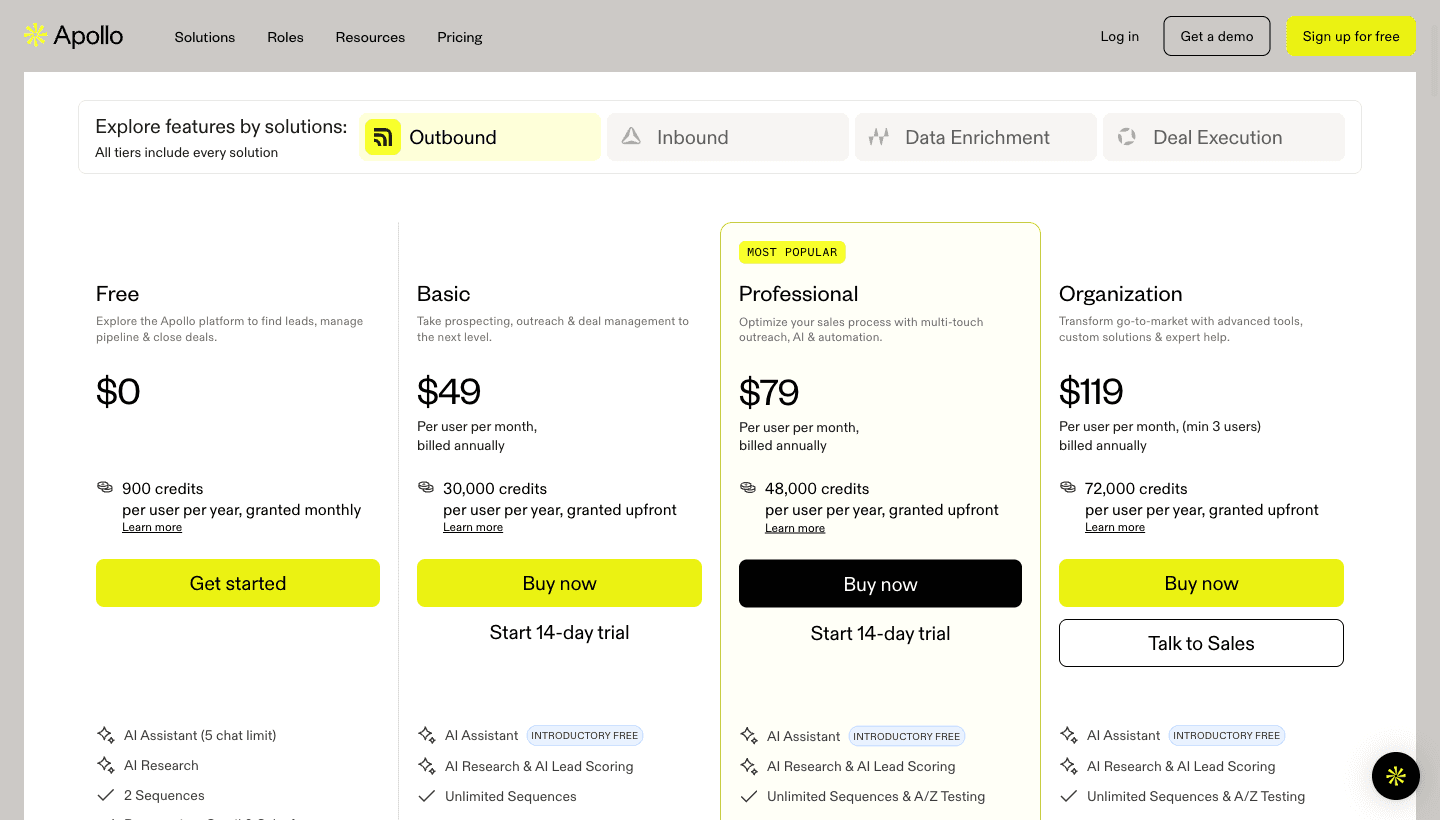
Apollo pricing is per-seat: Free (75 credits/mo), Basic $49/user/mo, Professional $79/user/mo, Organization $119/user/mo. All paid plans require annual billing. A 5-person team on Professional costs $395/month or $4,740/year. Credits vary: 1 per email, 8 per phone number.
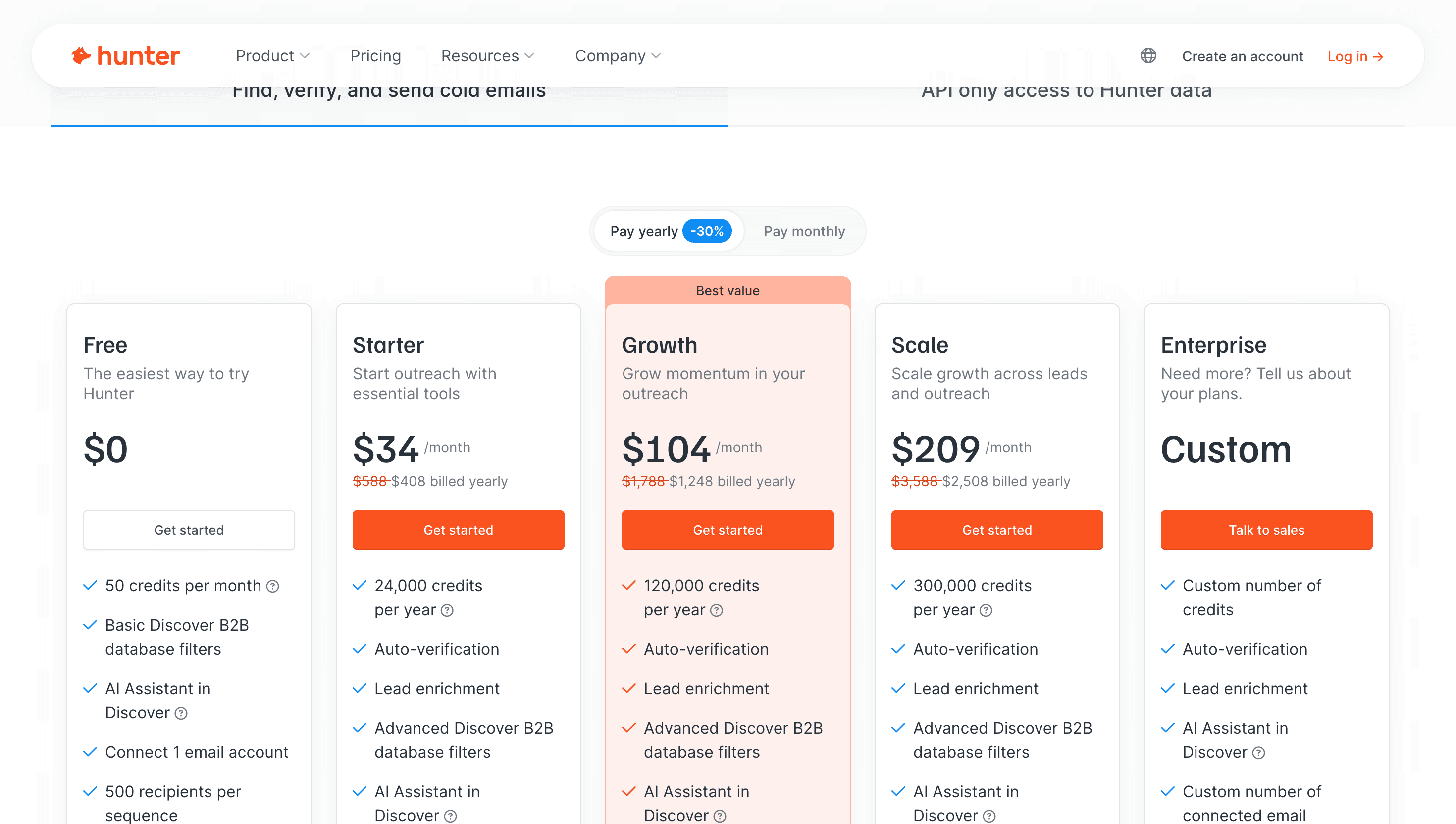
Hunter pricing is credit-based: Free (50 credits/mo), Starter $34/mo (2K credits), Growth $104/mo (10K credits), Scale $209/mo (25K credits). No per-seat fees — unlimited team members on all plans. One credit per email lookup, half a credit per verification.
Hunter is clearly cheaper for teams. But if you factor in the missing phone data and enrichment features, you may end up paying for a second tool to fill the gaps.
Enrich pricing for comparison: Growth Pack $49/mo (100K credits), Scale Pack $149/mo (500K credits), Pro Pack $499/mo (2.5M credits). Credit costs: Email Validation = 1 credit, Email Finder = 10 credits, Reverse Lookup = 10 credits, Phone Finder = 500 credits. No per-seat fees, no annual contracts. 100 free credits to start.
Apollo offers a REST API with reasonable documentation. Rate limits are tied to your plan tier. The API covers contacts, companies, sequences, and some engagement data. SDKs are community-maintained, not official. Response times are adequate but not exceptional.
Hunter provides a clean, well-documented REST API. The Email Finder, Email Verifier, and Domain Search endpoints are straightforward. Hunter also offers MCP server integration for AI agents. Response times are good for email lookups.
Enrich has the strongest developer experience: official TypeScript and Go SDKs with full type safety, sub-200ms average response time, webhook support for async workflows, and a native MCP server. API documentation at doc.enrich.so includes code examples for every endpoint.
For teams building programmatic enrichment pipelines, API quality matters. Enrich and Hunter are both developer-friendly. Apollo's API is functional but secondary to the platform UI.
Apollo and Hunter are both good tools — for different jobs. Apollo is a sales platform with enrichment built in. Hunter is an email finder with outreach built in. But if what you actually need is the data enrichment layer, both leave gaps.
Enrich fills those gaps: a verified match rate exceeding 94%, full-stack enrichment (email + phone + reverse lookup + company + leads + people search + waterfall enrichment + company follower analysis), credit-based pricing from $49/mo for 100K credits, and no per-seat fees. A 5-person team pays $588/year instead of Apollo's $4,740/year.
Beyond core enrichment, Enrich offers a Lead Finder with 300M+ contacts and 100+ search filters (job title, industry, seniority, technographics, funding data, hiring signals, traffic data) with free count queries and up to 25 contacts revealed per request. People Search finds employees at any company by LinkedIn URL at 1 credit per person. Waterfall Enrichment runs multi-source cascading lookups with ICP scoring from 0 to 100 at 1 credit per record. Company Follower Analysis scrapes LinkedIn company followers with free count estimation at 25 credits per profile. The platform also includes Ring Enrichment for phone verification, built-in Data Tables with CSV import/export, CRM integrations with Salesforce and HubSpot, and MCP server support for AI agents.
Start with Enrich's 100 free credits to compare data quality. Then use Hunter for cold email sequences or Apollo for the full platform — but feed them enriched data from Enrich.
Apollo has a larger database (210M+ contacts) but Hunter has higher email finding accuracy with 6M+ users trusting its data. For pure email finding, Hunter is more focused. For email + phone + sequences + CRM, Apollo offers more. Enrich offers over 94% accuracy on email finding at $49/mo for 100K credits.
Yes, some teams use Apollo for prospecting and sequences while using Hunter for email verification. However, this means paying for two tools. Enrich can replace both for the enrichment layer at lower cost, while you use Apollo or Hunter for outreach.
Hunter is cheaper for most teams because it uses credit-based pricing without per-seat fees. A team of 5 on Hunter Growth pays $104/mo total. The same team on Apollo Professional pays $395/mo. Enrich is even cheaper at $49/mo for 100K credits with no per-seat fees.
100 free API credits. No credit card required. Start enriching data in minutes.