BlogGuides
Clay Pricing: Plans, Credits, and True Cost of Enrichment

By Rahul LakhaneyPublished on: Mar 30, 2026 · 12 min read · Last reviewed: Mar 2026
On this page
TL;DR
Clay's pricing is deceptively complex. The platform fee ($149 to $800/mo) is just the beginning. Each enrichment lookup costs Clay credits AND provider credits, making the true cost of a single record much higher than it appears.
Monthly cost by lookup volume
| Volume | Clay Starter | Clay Explorer | Clay Pro | Clay Enterprise | Enrich Growth | Enrich Scale |
|---|---|---|---|---|---|---|
| Platform fee | $149/mo | $349/mo | $800/mo | Custom | $49/mo | $149/mo |
| Credits included | 2,000/mo | 10,000/mo | 50,000/mo | Custom | 100,000/mo | 500,000/mo |
| Records enriched | ~200-600 | ~1,000-3,000 | ~5,000-16,000 | Custom | 100,000 | 500,000 |
Clay is a data enrichment and automation platform that uses "waterfall enrichment" to check multiple data providers for each lookup. It is a powerful concept, but the pricing model is more complex than most teams realize.
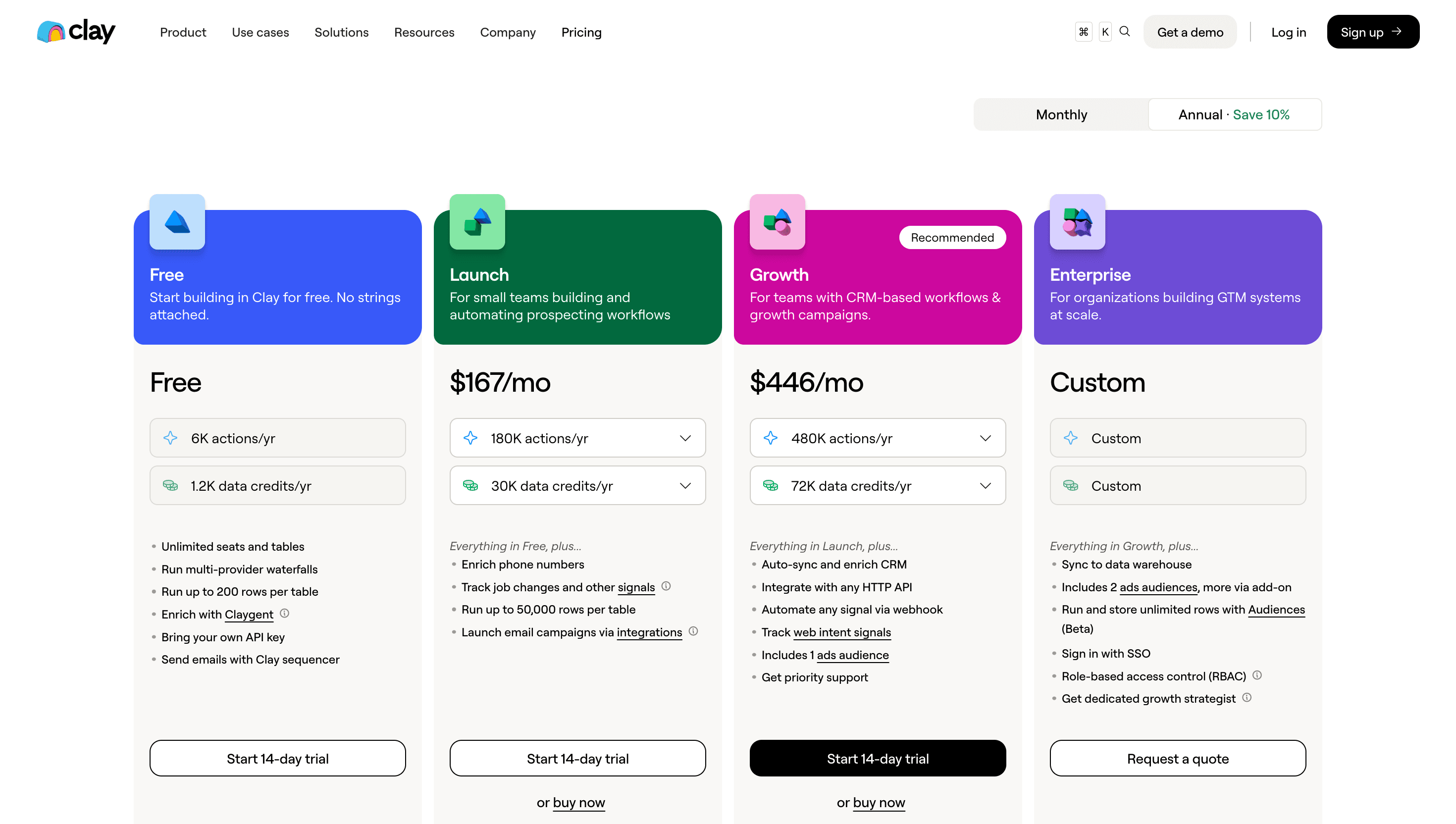
Clay has four pricing tiers:
The first thing to understand: these credits are Clay credits, not enrichment lookups. A single enrichment action can consume 3 to 10+ Clay credits depending on the provider and action type. Finding an email might cost 3 Clay credits, enriching a full profile might cost 5 to 8 credits, and running a waterfall across multiple providers can cost 10+ credits per record.
This means Clay's Starter plan (2,000 credits) translates to roughly 200 to 600 fully enriched records per month, not 2,000. The Pro plan (50,000 credits) covers approximately 5,000 to 16,000 records depending on your workflow complexity.
Here is where Clay's pricing gets really expensive. Clay credits are just the platform fee. Many enrichment providers on Clay's marketplace also charge their own credits or fees.
Let me walk through a typical waterfall enrichment workflow on Clay:
A single waterfall email lookup can consume 7 to 10+ Clay credits across attempts, plus the underlying provider fees. If you are on the Starter plan (2,000 credits/month), that is roughly 200 to 285 waterfall lookups before your Clay credits run out, and you still owe the provider fees on top.
Some providers are "included" in Clay's credits (Clay covers the provider cost). But many premium providers require you to bring your own API key, meaning you pay Clay credits AND the provider's per-lookup price. The total cost per record can easily exceed $0.10 to $0.50 depending on the providers used.
Compare this to Enrich's Waterfall ICP Search: 1 credit per record, all-inclusive. No separate provider fees, no double-billing. On the Growth Pack ($49/mo, 100K credits), you can waterfall-enrich 100,000 records per month. That same volume on Clay Pro ($800/mo) would cost thousands in Clay credits plus additional provider fees.
I ran the numbers on what a typical enrichment workflow costs per record on Clay versus Enrich.
Scenario: Waterfall email finding + verification for 1,000 contacts
Scenario: Full enrichment (email + phone + company data) for 5,000 contacts
The cost differential is 50x to 100x. Clay is a powerful automation platform, but for pure data enrichment, the economics strongly favor Enrich.
To be fair, comparing Clay purely on enrichment cost misses the full picture. Clay is more than a data provider. It is a workflow automation platform that happens to include enrichment.
Clay excels at:
Complex multi-step workflows. Clay lets you build visual workflows that combine enrichment with AI-powered research, scoring, personalization, and outreach preparation. If you need to enrich a contact, research their company's recent funding, generate a personalized opening line with AI, and push the result to your sequencer, Clay can do that in a single automated flow.
Provider flexibility. Clay connects to 75+ data providers. If one provider does not have data on a contact, Clay automatically tries the next one in your waterfall. This "bring your own providers" approach gives you maximum coverage.
AI-powered enrichment. Clay's AI agent (Claygent) can browse websites, extract specific data points, and answer custom research questions about prospects. This goes beyond structured database lookups.
Spreadsheet-like interface. Clay's UI is a smart spreadsheet where each column can trigger an enrichment or AI action. For non-technical users, this is more accessible than writing API integrations.
If you need these workflow automation capabilities, Clay provides real value despite the higher cost. But if your primary need is data enrichment (finding emails, verifying contacts, getting phone numbers, company data), you are paying a significant premium for automation features you may not use.
Here is how I think about the choice between Clay and Enrich:
Many teams use both: Enrich for high-volume, cost-effective enrichment via API, and Clay for complex research workflows on high-value accounts. Enrich is also available as a provider within Clay, so you can use Enrich's data inside Clay's workflows.
For a deeper comparison, see our full Enrich vs Clay analysis.
Clay's paid plans start at $149/month (Starter, 2,000 credits), $349/month (Explorer, 10,000 credits), and $800/month (Pro, 50,000 credits). Enterprise pricing is custom. Note that Clay credits are not 1:1 with enrichment lookups. A single waterfall lookup can consume 3 to 10+ credits.
Clay Pro includes 50,000 credits per month. Depending on your workflow, each enriched record costs 3 to 15 Clay credits. A typical waterfall email lookup costs 7 to 10 credits. This means Pro covers roughly 5,000 to 16,000 enriched records per month, not 50,000.
It depends on the provider. Some providers are covered by Clay credits. Premium providers require you to bring your own API key and pay the provider directly, on top of Clay credits. This double-billing makes the true cost per record higher than the Clay credit cost alone.
For cost-effective waterfall enrichment, Enrich is significantly cheaper. Enrich's Waterfall ICP Search costs 1 credit per record (all-inclusive). Clay's waterfall consumes 7 to 10+ Clay credits per record plus potential provider fees. Enrich Growth ($49/mo) can waterfall-enrich 100,000 records, while Clay Pro ($800/mo) covers roughly 5,000 to 7,000 waterfall lookups.
Yes. Enrich is available as a data provider within Clay's platform. You can use Enrich's enrichment endpoints inside Clay workflows. However, for high-volume enrichment, using Enrich's API directly ($49/mo for 100K credits) is more cost-effective than routing through Clay, which adds Clay credit costs on top.
100 free API credits. No credit card required. Start enriching data in minutes.