BlogComparisons
Hunter vs Apollo: Cold Outreach Showdown

By Rahul LakhaneyPublished on: May 20, 2026 · 9 min read · Last reviewed: May 2026
On this page
TL;DR
Hunter is a focused email finder and verifier with a clean sequencer. Apollo is a full sales platform where email finding is one feature among many. Here is which one wins for cold outreach — and a third option that lifts match rates above both.
Feature matrix across all tools reviewed
| Feature | Hunter | Apollo | Enrich |
|---|---|---|---|
| Core purpose | Email finder + verifier | All-in-one sales platform | Enrichment API |
| Database | Domain-based discovery | 210M+ contacts | 300M+ contacts |
| Email verification | 0.5 credit/check | 1 credit | |
| Phone numbers | Credit-gated | ||
| Sequences | Simple | Advanced | |
| Built-in dialer | |||
| Free plan | 50 credits/mo | 75 credits/mo | 100 free credits |
| Entry paid plan | $34/mo (annual) | $49/user/mo | $49/mo (100K credits) |
| Reverse email lookup | |||
| MCP / AI agents |
Monthly cost by lookup volume
| Volume | Hunter | Apollo (per seat) | Enrich |
|---|---|---|---|
| Free | 50 credits/mo | 75 credits/mo | 100 credits |
| Entry paid | $34/mo (Starter) | $49/user/mo (Basic) | $49/mo (100K credits) |
| Mid-tier | $104/mo (Growth) | $79/user/mo (Professional) | $149/mo (500K credits) |
| Top tier | $209/mo (Scale) | $119/user/mo (Organization) | $499/mo (2.5M credits) |
Choose Hunter if cold email is your primary channel and you want the cleanest email finding and verification with a simple sequencer. Hunter's data is reliable, its credit math is honest, and its free plan is the most generous in the category.
Choose Apollo if you want more than email: a 210M+ contact database, phone numbers, a built-in dialer, and sequencing in one platform with a free tier and transparent per-seat pricing.
Choose a waterfall enrichment layer like Enrich if your real bottleneck is match rate. Instead of one provider's hit rate, waterfall enrichment checks several sources per contact and keeps the first verified result.
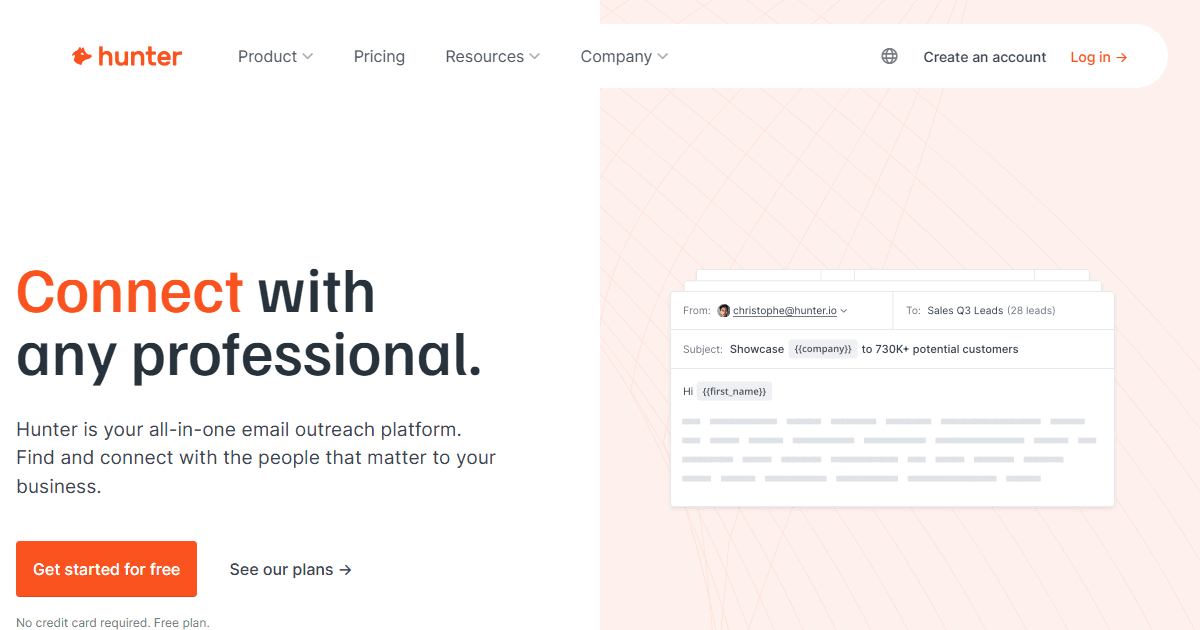
Hunter does one job and does it cleanly: find verified work emails and check that they are deliverable. The Email Finder, Domain Search, and Email Verifier are the most straightforward in the category, and the credit model is honest, you only spend a credit when Hunter returns a real result. That reliability is why agencies and SDR teams running list building consistently rate Hunter's data as cleaner than broader platforms.
Hunter also has the most generous free plan in the space, 50 credits a month with one connected mailbox, which is enough to genuinely evaluate the product. Paid plans are simple: Starter at $34/mo, Growth at $104/mo, and Scale at $209/mo (all billed annually), with a single shared credit pool across finding and verification. Email verification only consumes 0.5 credits per check.
The limitation is scope. Hunter has no phone numbers, no intent data, and a shallower contact database than a full sales platform. Its sequencing is functional but basic. If your outbound stretches beyond email, you will be stacking Hunter with other tools.
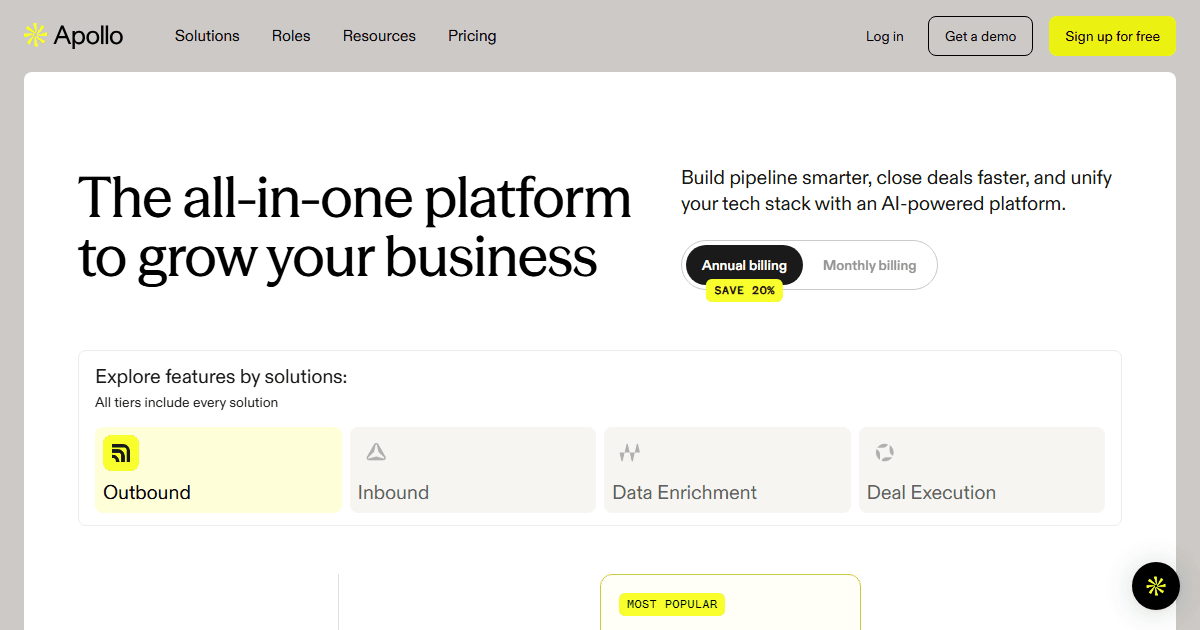
Apollo is a platform, not a feature. You search a 210M+ contact database, reveal emails and phone numbers, push prospects into multi-step sequences, dial them with the built-in phone, and track deals, all in one place. For a team that wants prospecting and engagement on one bill, that breadth is the whole point.
Apollo's pricing is public and self-serve: Free, Basic at $49 per user per month, Professional at $79, and Organization at $119 billed annually. The free plan is usable, and the data is broad enough for most SMB outbound. Where Hunter is a scalpel, Apollo is a Swiss Army knife.
The trade-off is data depth versus breadth. Practitioners often find Apollo's email data slightly less clean than Hunter's focused finder, and mobile numbers are credit-gated with variable hit rates.
Email finding accuracy: Hunter has the edge for pure email discovery. Its domain-based finder and verification pipeline produce clean, deliverable addresses, and reviewers regularly describe Hunter's data as more reliable for list building. Apollo finds more contacts overall thanks to its database, but the email quality per contact is generally rated a notch below Hunter's focused finder.
Email verification: Both verify, but Hunter's verifier is a category benchmark and only charges half a credit per check. Apollo verifies as part of its workflow. If verification quality is a deciding factor, Hunter has the stronger reputation.
Data depth and phone numbers: Apollo wins decisively. It offers a massive contact database with firmographics, basic intent on higher tiers, and phone numbers, none of which Hunter provides.
Sequencing and engagement: Apollo's sequencing and built-in dialer are more advanced, supporting multi-channel cadences and call tasks. Hunter's Campaigns feature handles straightforward email sequences well but is intentionally simpler.
Pricing and value: Both are transparent and self-serve. Hunter is cheaper for pure email work, with Starter at $34 per month on annual billing and a generous free plan. Apollo costs more per seat but bundles far more capability.
Both tools depend on their own data, and any single source misses contacts. Waterfall enrichment fixes the match-rate ceiling that both Hunter and Apollo eventually hit.
Enrich checks multiple data providers in sequence for each contact and keeps the first verified result, returning one CRM-ready record with both email and phone. That means higher overall fill rates than either tool alone, on transparent per-credit pricing, with an API and MCP server for teams that want enrichment inside their own workflows. Many teams use Hunter or Apollo for sequencing and put Enrich underneath as the data layer that feeds clean records in.
Choose Hunter if cold email is your main channel and you want the cleanest finding and verification with a simple sequencer.
Choose Apollo if you want phone numbers, a bigger database, a dialer, and advanced sequences in one platform.
Choose waterfall enrichment if your bottleneck is match rate and you want clean email and phone data feeding whatever sequencer you already run.
For pure email-led cold outreach, Hunter has the edge on data cleanliness and verification, which matters for deliverability. Apollo wins if your outreach is multi-channel and you also want phone numbers, a dialer, and a larger database in one tool.
Apollo finds more contacts overall because of its database, but reviewers generally rate Hunter's focused finder as cleaner per contact. If email accuracy and deliverability are your top priority, Hunter is the stronger single-purpose finder.
No. Hunter is an email-only tool with no phone or mobile data. If you need direct dials, Apollo provides them (credit-gated), or you can use a waterfall enrichment layer like Enrich that returns both email and phone.
Hunter is cheaper for pure email work, starting at $34 per month on annual billing with a generous free plan. Apollo costs more per seat but bundles a database, phones, a dialer, and advanced sequencing.
For teams focused on match rate and clean CRM data, a waterfall enrichment platform like Enrich is the strongest alternative because it pulls from several providers rather than one. Enrich also offers reverse email lookup, phone finding, and an MCP server for AI workflows.
100 free API credits. No credit card required. Start enriching data in minutes.